Overview
Big Linear Mixed Models (BLMM) is a Python toolbox designed for fitting mass-univariate linear mixed models at scale—an approach especially well-suited for neuroimaging applications involving large cohorts and high-dimensional surface or voxelwise outcomes. In this tutorial, we walk through how to understand and interpret BLMM outputs using results derived from ABCD Study® neuroimaging data. The analyses featured here come from two mass-univariate linear mixed models applied to cortical surface data collected during the ABCD working-memory N-back task. In this experiment, the response variable of interest was the percent BOLD (Blood Oxygenation Level Dependent) signal, examined across thousands of brain locations. In this example we focus on interpreting the BLMM results, examining what the BLMM toolbox produces, how to read its statistical outputs, and how to draw clear scientific conclusions from them.
Stats
Data Access
Study Background
The data presented in this tutorial are drawn from the Adolescent Brain Cognitive Development (ABCD) Study, the largest long-term study of brain development and child health in the United States. The ABCD Study follows approximately 12,000 youth from age 9-10 through early adulthood, collecting neuroimaging, behavioral, and environmental data at regular intervals.
Task and Response Variable
The experiment conducted in this study was a working memory N-back task. The response variable of interest was the percent BOLD (Blood Oxygenation Level Dependent) signal—a measure of blood flow in the brain which acts as a proxy for neuronal activity.
Prior analyses produced a 2-vs-0 back contrast image for each subject and session, reflecting the subject's average percent BOLD change in response to the 2-back task during a particular session. In each image, the average percent BOLD change is recorded for every vertex on a predefined cortical surface.
Sample Characteristics
In total, the response data consists of 9,835 fMRI surface images. These images were drawn from 5,179 subjects, each of whom had data recorded for between 1 and 3 visits.
Viewer Data
The pre-processed BLMM results used by the interactive viewer are available in the public/data/blmm/ directory. This includes:
- Surface geometry: FreeSurfer fsaverage5 pial surfaces (10,242 vertices per hemisphere)
- Statistics: T-statistics, -log₁₀(p-values), beta coefficients, and residual variance for each contrast
- Metadata: JSON files describing volume labels, colormaps, and suggested thresholds
These files represent aggregated vertex-wise statistics derived from the BLMM analysis—not the original subject-level fMRI images, which remain under ABCD data use agreements.
Design Matrix
We are interested in understanding how a range of independent variables impacted the task-specific percent BOLD response. The design matrix for both analyses included:
- Intercept: Modeling average response
- Sex: The subject's biological sex
- Cross-sectional Age: The age of the subject at the first timepoint
- Longitudinal Time: The difference in the subject's age from the first timepoint recorded
- NIH Cognition Score (Age Corrected): The subject's age-corrected total score from the neurocognitive battery derived from seven measures from the NIH Toolbox
- Race: Categorical variable indicating the subject's race (white, black, asian, or other)
- Ethnicity: Categorical variable indicating the subject's ethnicity (hispanic or other)
- Parental Education Level: Categorical variable representing the subject's parent's education (high school, college, bachelor, postgraduate)
- Family Income: Categorical variable representing the subject's family income (less than 50K, 50K-100K, greater than 100K)
- Marital Status: Categorical variable representing the marital status of the subject's parents
Data Preparation
The Linear Mixed Model can be represented in the form:
where, assuming the model includes observations, fixed effects and random effects, the model matrices are:
- : the fixed effects (independent variables) design matrix
- : the random effects design matrix
The random terms are:
- : the response vector
- : the error vector
- : the random effects vector
Our interest lies in estimating the parameters:
- : the fixed effects coefficient vector
- : the scalar residual variance
- : the random effects covariance matrix
The input and output of BLMM is labeled according to these notational conventions.
The two analysis designs differed in the random effects included in the model:
- Design 1: Included a subject-level intercept as a random effect. This models the within-subject variability in the data.
- Design 2: Included both a subject-level intercept and longitudinal time effect. This models the variation in individual subject's trajectories.
As random slopes cannot be considered for singleton subjects (those with only one observation), Design 2 was constrained to consider only subjects with 2 or more visits.
# Example blmm_inputs.yml structure
Missingness:
  MinPercent: 0.5
X: /path/to/X.csv
Y_files: /path/to/y_files.txt
analysis_mask: /path/to/analysis/mask
clusterType: SLURM
Z:
- f1:
    design: /path/to/factor_design_matrix.csv
    factor: /path/to/factor_vector.csv
contrasts:
- c1:
    name: Intercept
    vector: [1, 0, 0, 0, 0, 0, 0, 0, 0, 0, 0, 0, 0, 0, 0, 0, 0, 0, 0, 0, 0, 0, 0]
- c2:
    name: Sex
    vector: [0, 1, 0, 0, 0, 0, 0, 0, 0, 0, 0, 0, 0, 0, 0, 0, 0, 0, 0, 0, 0, 0, 0]
- c3:
    name: CrossSectionalAge
    vector: [0, 0, 1, 0, 0, 0, 0, 0, 0, 0, 0, 0, 0, 0, 0, 0, 0, 0, 0, 0, 0, 0, 0]
- c4:
    name: LongitudinalTime
    vector: [0, 0, 0, 1, 0, 0, 0, 0, 0, 0, 0, 0, 0, 0, 0, 0, 0, 0, 0, 0, 0, 0, 0]
- c5:
    name: NIHScore
    vector: [0, 0, 0, 0, 1, 0, 0, 0, 0, 0, 0, 0, 0, 0, 0, 0, 0, 0, 0, 0, 0, 0, 0]
outdir: /path/to/output
In the configuration file:
- Missingness: The
MinPercent: 0.5parameter tells BLMM to report results for any vertex with at least 50% of observations present - X.csv: Contains the fixed effects design matrix of size
- Y_files.txt: A text file containing paths to the surface images
- analysis_mask: Specifies which vertices to analyze
- clusterType: The type of computational cluster (e.g., Local, SLURM, SGE)
- Z: Specifies random effects structure. The
factorfile is an vector indicating which subject each observation belongs to. Thedesignfile contains the random effects design matrix. - contrasts: Defines the null hypotheses to test (here: Intercept, Sex, Age, Time, NIH Score)
Statistical Analysis
import os
import numpy as np
import nibabel as nib
from demo.plot import plot_brain_surface

# Geometry file paths (FreeSurfer pial surfaces)
geom_lh = "demo/geom/lh.pial"
geom_rh = "demo/geom/rh.pial"
BLMM produces the following output files for each analysis:
| File | Description | Dimensions |
|---|---|---|
blmm_vox_beta.dat | Fixed effect estimates (β) | vertices × 23 coefficients |
blmm_vox_con.dat | Contrast estimates | vertices × 5 contrasts |
blmm_vox_conSE.dat | Standard errors for contrasts | vertices × 5 contrasts |
blmm_vox_conT.dat | T-statistics for contrasts | vertices × 5 contrasts |
blmm_vox_conTlp.dat | -log₁₀(p-values) | vertices × 5 contrasts |
blmm_vox_sigma2.dat | Residual variance (σ²) | vertices × 1 |
blmm_vox_D.dat | Random effects covariance (D) | vertices × elements of D |
blmm_vox_n.dat | Sample size per vertex | vertices × 1 |
blmm_vox_llh.dat | Log-likelihood | vertices × 1 |
blmm_vox_edf.dat | Effective degrees of freedom | vertices × 1 |
Results are organized by hemisphere (lh/rh) and design (des1/des2).
# Specify the analysis to examine
analysis = "des1"  # or "des2" for random slopes model
hemisphere = "lh"  # or "rh"

# Load t-statistics for contrasts
data_path = f"demo/results_{hemisphere}_{analysis}/blmm_vox_conT.dat"

# Visualize a specific contrast (volume_number selects the contrast)
# Volume 0 = Intercept, 1 = Sex, 2 = Age, 3 = Time, 4 = NIH Score
plot_brain_surface(data_path, geom_lh, volume_number=1)
Use the interactive viewer below to explore BLMM outputs across designs, contrasts, and statistics. Start with Design 1 and the conT statistic, then adjust the contrast volume and threshold to see how patterns shift across the cortex.
In the viewer, set Design 1, Statistic = conT, and Volume = 1 (Sex). Key observations:
- Color scale: Blue indicates negative effects, red indicates positive effects
- Threshold: Values with |t| < 2.0 are shown in gray (approximately p > 0.05)
- Spatial patterns: Strong bilateral effects are visible in frontal and parietal regions associated with working memory
To compare BLMM outputs, keep the same design and contrast, then switch the statistic in the viewer:
- beta (β): Raw fixed effect coefficients. Values represent the estimated change in percent BOLD per unit change in the predictor.
- conT: T-statistics for testing whether contrasts differ from zero. Larger absolute values indicate stronger evidence against the null hypothesis.
- conTlp: Negative log₁₀ of p-values. Values > 1.3 correspond to p < 0.05; values > 2 correspond to p < 0.01. This transformation makes significant regions more visually apparent.
- sigma2 (σ²): Residual variance at each vertex. Higher values indicate more unexplained variability in the BOLD response.
Use the viewer to step through the five contrasts (Volume 0–4) and compare spatial patterns:
- Volume 0 (Intercept): Average BOLD response during the 2-back task
- Volume 1 (Sex): Difference in BOLD response between males and females
- Volume 2 (Cross-sectional Age): Association between baseline age and BOLD response
- Volume 3 (Longitudinal Time): Change in BOLD response over time within individuals
- Volume 4 (NIH Score): Association between cognitive performance and BOLD response
Each contrast reveals distinct spatial patterns, reflecting the neural correlates of these demographic and cognitive factors.
Can't access the interactive viewer? Click to view static visualizations
The images below show key BLMM outputs for reference. These are static versions of what the interactive viewer displays.
T-Statistics Overview (Both Hemispheres)
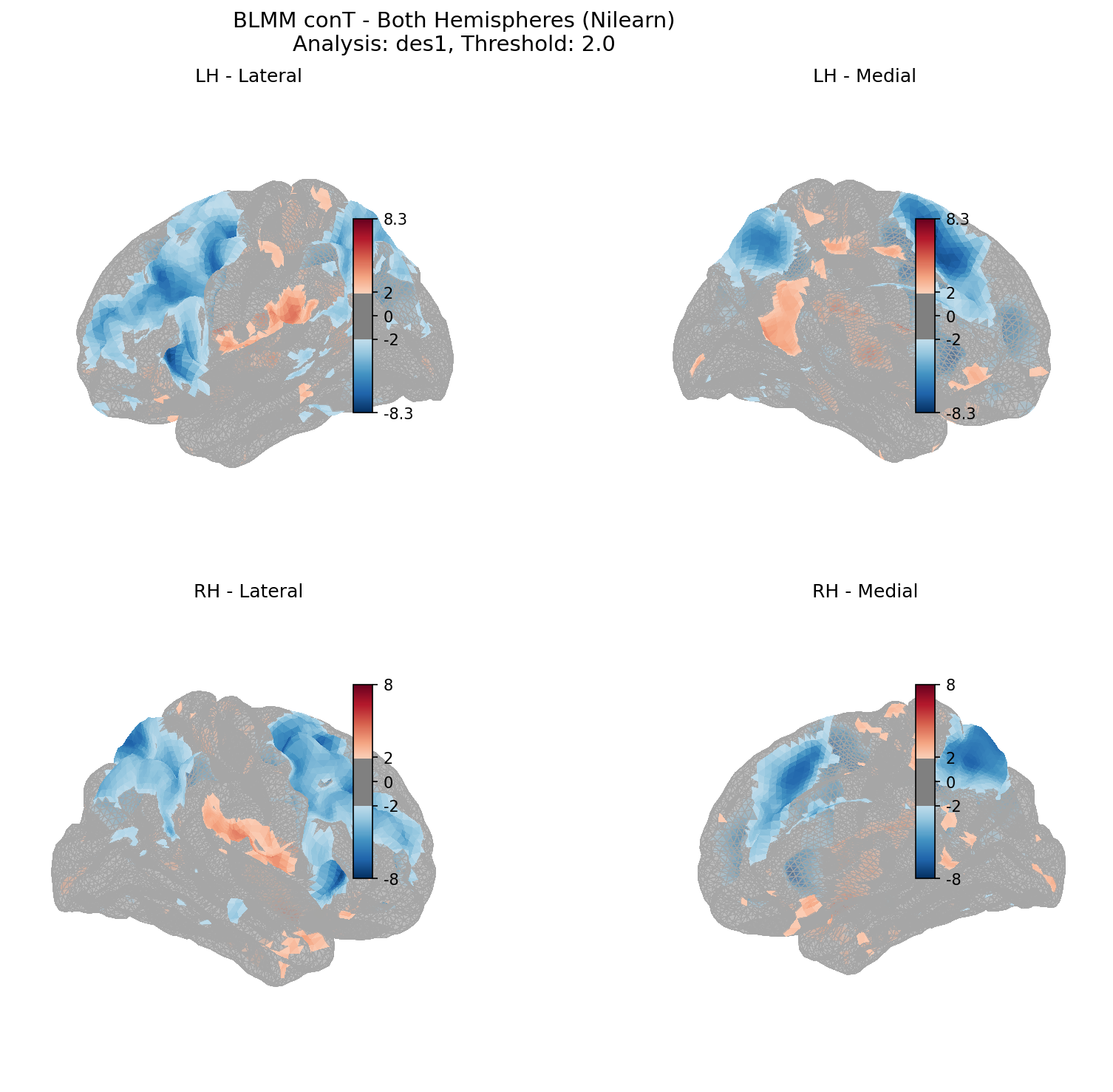
T-statistics from Design 1 (random intercepts only) mapped onto both cortical hemispheres. Blue indicates negative effects, red indicates positive effects. Values with |t| < 2.0 are shown in gray.
Statistics Comparison
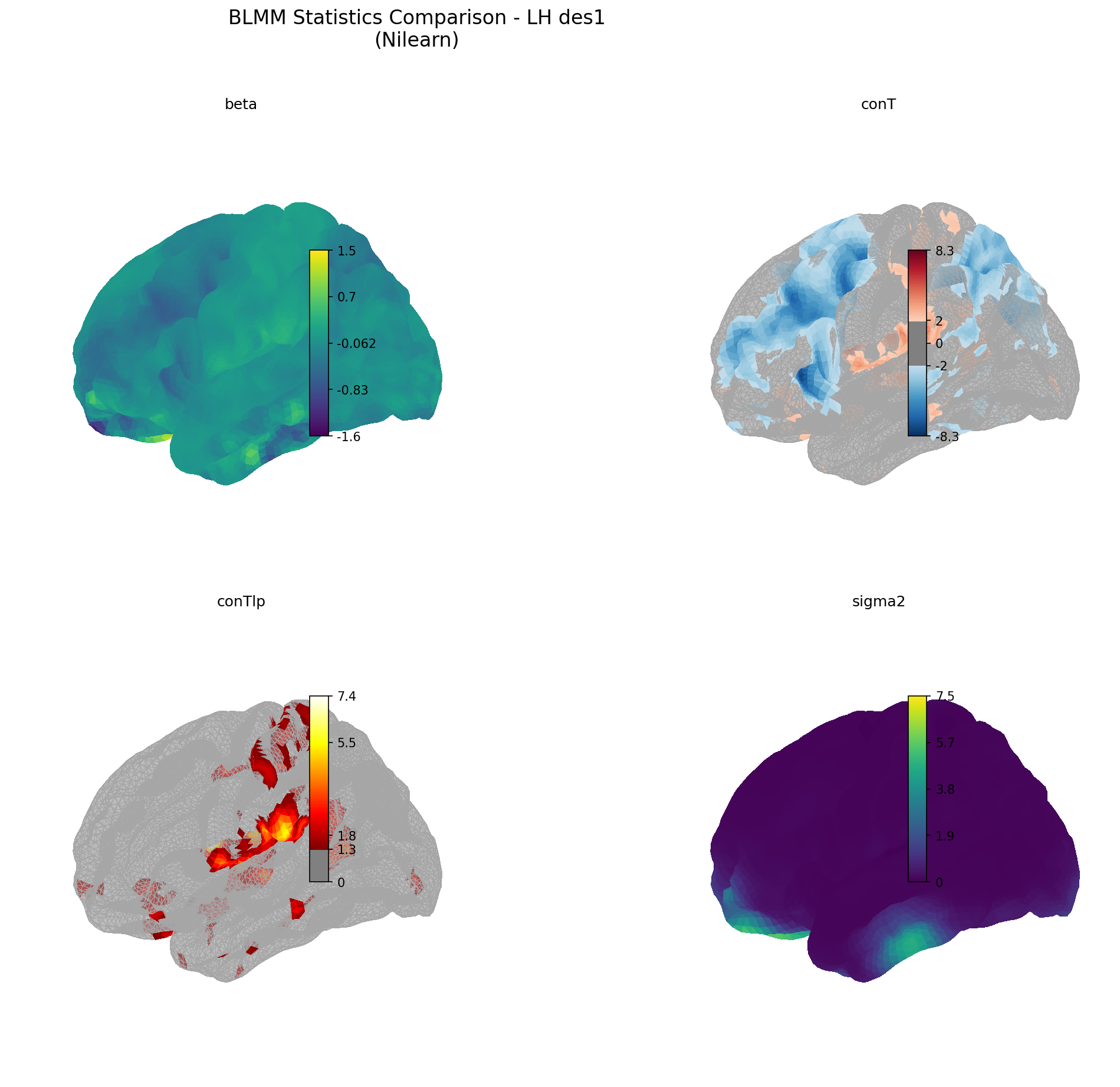
Four key output types from BLMM: beta coefficients (β), t-statistics (conT), negative log₁₀ p-values (conTlp), and residual variance (σ²). Each reveals different aspects of the analysis results.
All Contrasts Overview
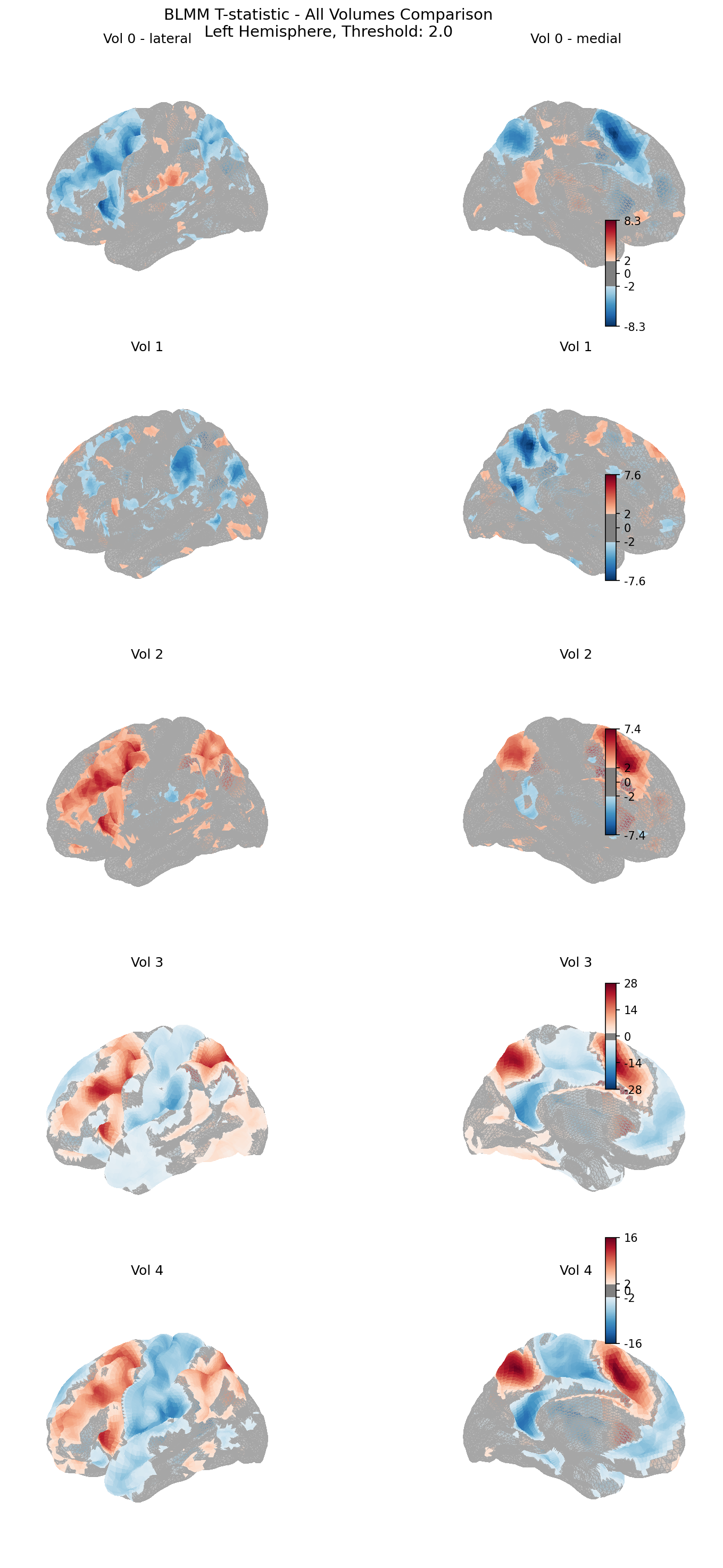
T-statistics for all five contrasts (Intercept, Sex, Cross-sectional Age, Longitudinal Time, NIH Score) displayed on the left hemisphere.
Discussion
Model Comparison
BLMM allows for formal comparison between nested models using likelihood ratio tests. In this example, we compared:
- Design 1: Random intercepts only (simpler model)
- Design 2: Random intercepts + random slopes for time (more complex model)
The comparison tests whether allowing individual trajectories to vary significantly improves model fit. This is implemented via the blmm_compare function, which outputs chi-squared statistics at each vertex.
Important: To perform comparison, the analyses must have equal sample sizes. The comparison shown is between Design 2 and a reduced version of Design 1 containing only subjects with 2 or more visits.
When to Choose Each Design
Design 1 (Random Intercepts) is appropriate when:
- You have many singleton subjects (single timepoint)
- Primary interest is in between-subject effects
- Computational resources are limited
Design 2 (Random Intercepts + Slopes) is appropriate when:
- Most subjects have multiple timepoints
- Individual trajectories are expected to vary
- You want to model heterogeneity in longitudinal change
Interpreting Results
When interpreting BLMM results:
- Multiple comparisons: With thousands of vertices tested, appropriate correction for multiple comparisons is essential (e.g., FDR, permutation testing)
- Effect sizes: T-statistics indicate statistical significance but not practical importance. Consider the magnitude of β coefficients.
- Spatial coherence: Isolated significant vertices may be noise; look for spatially coherent clusters
Limitations
- BLMM assumes normally distributed residuals; violations may affect inference
- The mass-univariate approach treats each vertex independently, ignoring spatial correlation
Additional Resources
5
Additional Resources
BLMM GitHub Repository
The official BLMM repository contains installation instructions, documentation, and example configurations for running your own analyses.
Visit ResourceBLMM NeuroImage Paper
The methodology paper describing the BLMM algorithm, validation studies, and computational approach.
Visit ResourceABCD Study
The Adolescent Brain Cognitive Development Study website with information about data access and study protocols.
Visit ResourceFreeSurfer
FreeSurfer is used for cortical surface reconstruction and provides the geometry files used in BLMM surface analyses.
Visit ResourceNilearn
Python library for neuroimaging data analysis and visualization, useful for exploring BLMM outputs.
Visit Resource